
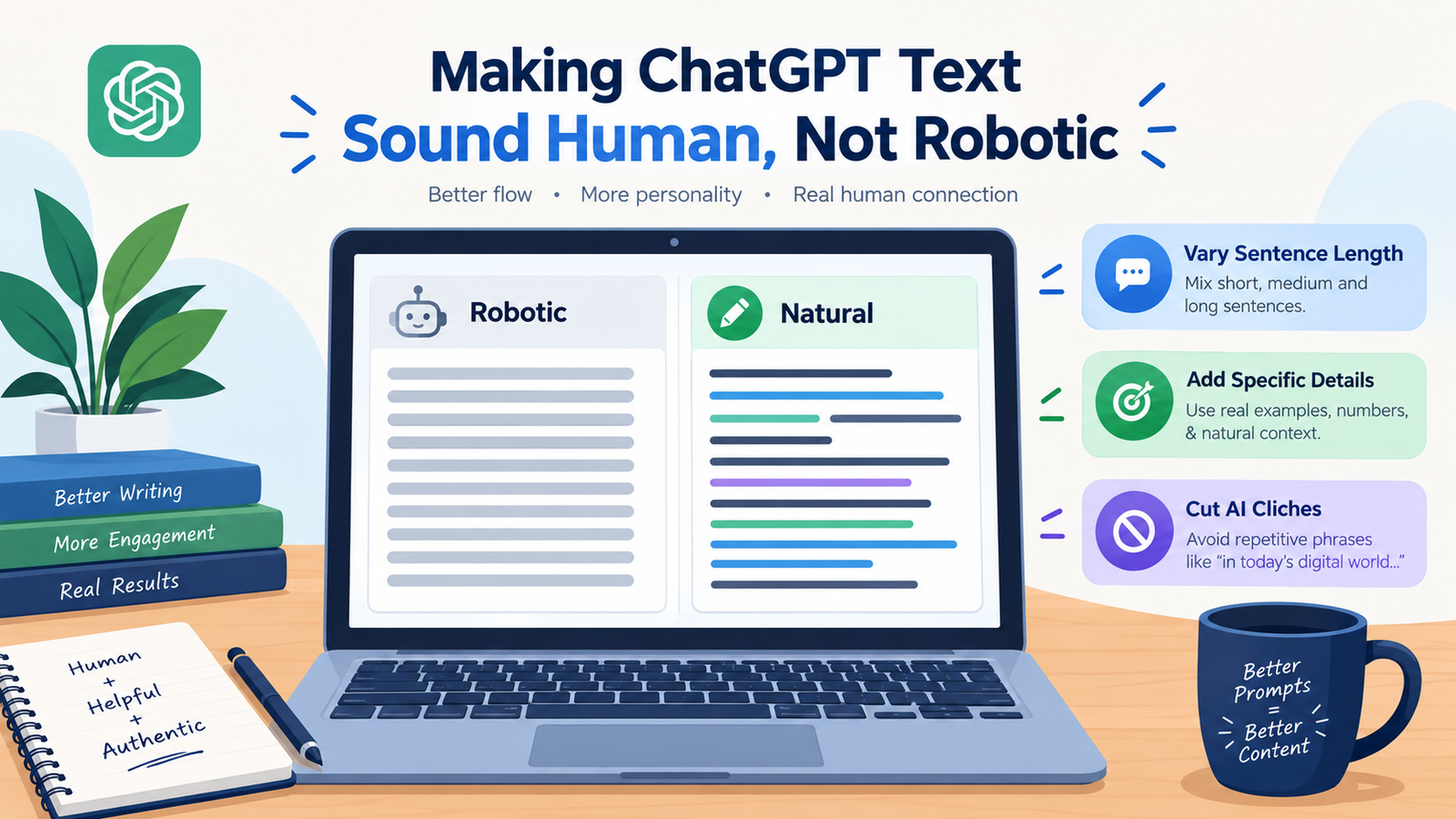
If you've ever handed a client AI-drafted content and gotten it back with "this sounds a bit robotic, can you make it more natural" - you've run into the actual problem freelancers face. It's not about tricking a detector. It's that ChatGPT's default output has recognizable patterns, and clients notice even without running anything through a checker.
What actually makes AI text sound robotic
A few specific patterns give it away every time:
- Uniform sentence length. Human writing naturally varies - a short sentence, then a longer one, then a fragment for emphasis. AI defaults to medium-length sentences with similar structure, one after another.
- Overused transition phrases. "Moreover," "in today's fast-paced world," "it's important to note that," "delve into" - these show up constantly in unedited AI output because the model reaches for them as safe connectors.
- Generic claims with no specific detail. "This tool offers many benefits" is AI's default; a human writer says "this cut our onboarding time from three days to about four hours."
The prompt that fixes this at the draft stage
Instead of generating a draft and editing it afterward, build these instructions into your original prompt so the first output needs less fixing:
Rule 3 does the most work here. Specificity is the single biggest signal of human writing - AI defaults to vague, safe statements because it's not drawing on one real, particular experience.
The second pass: editing what ChatGPT gives you
Even with a good prompt, the first draft usually needs a real edit. Three things to check every time:
- Read it out loud. Sentences that sound stiff when spoken usually read as robotic too. If you stumble over a sentence, rewrite it the way you'd actually say it.
- Cut the throat-clearing. AI drafts often open paragraphs with a sentence that restates the obvious before getting to the point. Delete the first sentence of a paragraph and see if it still makes sense - often it reads better without it.
- Add one detail only you would know. A specific tool name, a real timeframe, a small imperfection or caveat - something a template genuinely couldn't generate because it's tied to the actual situation, not a generic version of it.
Why this matters more than finding a "humanizer" tool
A large market of tools exists specifically to run text through an algorithm and make it pass AI detectors. These are built for evading academic plagiarism checks and don't solve the actual problem freelancers have - a client isn't running your work through a detector, they're reading it and deciding whether it sounds like something a person who understands their business actually wrote. Editing for genuine specificity and natural rhythm fixes that; a detector-bypass tool only fixes the score on a checker nobody on your client's side is using.